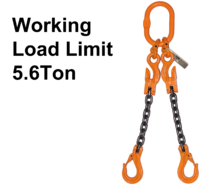
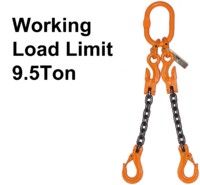
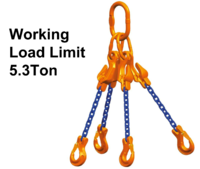
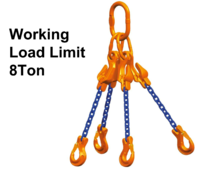
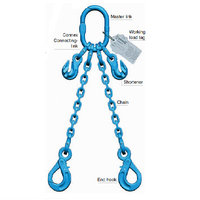
Chain Slings

Browse our selection of 1 Leg, 2 Leg and 4 Leg Chain Slings, designed and manufactured for optimum reliability, accuracy and durability even under harsh conditions. 

As a leading chain sling manufacturer, Prolift Handling assemble and supply a wide range of certified lifting chain assemblies and components for both grade 80 and grade 100 to meet all safe working load (SWL) requirements. Single Leg, 2 Leg Chains, or 4 Leg Chain Sling Assemblies in any length with shorteners for working length adjustment. Sets of Lifting Chain are also available with either safety hook or sling hook configurations. All chain slings supplied by Prolift Handling arrive fully tested, stamped and test certificate issued. 

We offer a full design service for chain slings in Ireland and can advise on loadings, end fittings and load attachments, site visits can be arranged where a complicated lift is the issue. Discuss your application today - call 01-4584836 or email websales@prolift.ie to speak to a sales advisor.
Chain Slings for Lifting, Rigging & Load Control

Chain slings are a durable, versatile lifting solution for demanding environments where abrasion, heat, sharp edges, or harsh site conditions can be a challenge. Used across construction, manufacturing, engineering, utilities, ports, and maintenance operations, lifting chain slings provide dependable performance for routine lifts and more complex rigging setups.

Our range includes 1 leg, 2 leg and 4 leg chain slings, with options for different hook types, shortening methods, and fittings. All assemblies should be correctly specified to the application, including load weight, pick points, and the required lifting angle.

Common Applications

  • Steel fabrication and structural lifting
  • Plant maintenance, machinery moves and shutdown work
  • Utilities and infrastructure projects
  • Loading bays, workshops and manufacturing facilities
  • General rigging where robustness is essential

Chain is often preferred when the lift involves contact with edges or surfaces that can damage textile slings.

1 Leg, 2 Leg & 4 Leg Chain Slings

The right sling configuration depends on how the load will be picked and balanced:

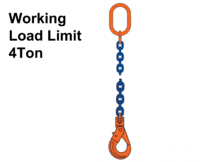
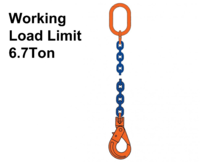
  • 1 Leg – straightforward vertical lifts with a single pick point
  • 2 Leg – two pick points for improved stability and load control
  • 4 Leg – multiple pick points for larger loads or complex rigging
  • Shortening options – adjust working length for uneven pick points

Sling leg angles, pick point spacing, and centre of gravity all affect the actual working load limit.

Chain Grades, Hooks & Fittings

Lifting chain slings are supplied in different grades (commonly Grade 10 and Grade 12). Higher grades can offer improved performance for a given chain diameter, but the correct choice depends on the application and site requirements.

  • Safety hooks, sling hooks and foundry-style options (application dependent)
  • Master links and intermediate links for multi-leg assemblies
  • Shorteners and shortening clutches for working length adjustment
  • Lifting points / shackles selected to match the sling configuration

The sling is only as strong as the overall system — compatibility of components matters.

Specification Essentials (What Affects WLL)

To ensure safe lifting, consider the following before selecting a chain sling:

  • Load weight and any potential for shifting during the lift
  • Number of pick points and their rated capacity
  • Sling angle (leg angle reduces the effective capacity)
  • Working length and need for shortening
  • Edge contact and how the sling will sit on the load

If you share basic lift details, we can help you select the safest, most practical configuration.

Inspection, Certification & Traceability

Chain slings should be identifiable and traceable, with appropriate documentation and routine inspection in line with usage and site policy. Regular checks help spot wear, deformation, damaged hooks, stretched links, and other issues that can affect safety.

Marking/ID for traceability
Test certification supplied where applicable
Pre-use checks and scheduled inspections
Repair/replace guidance when damage is found

If you need support with selecting, inspecting, or maintaining chain slings, our team can advise.

Request Help Specifying the Correct Chain Sling

Send us the load weight, number of pick points, and any lifting angle constraints — we’ll recommend a suitable 1 leg, 2 leg, or 4 leg chain sling configuration with the right hooks and fittings.

Handy details to include: load weight, pick point spacing, lift angle, headroom, and whether shortening is required.

Frequently Asked Questions

1) How do I choose between a 1 leg, 2 leg, or 4 leg chain sling?

It depends on the number of pick points and how stable the load needs to be. Single leg slings suit single pick lifts, while 2 and 4 leg slings help spread load across multiple attachment points and improve control.

2) Does the sling angle reduce the working load limit (WLL)?

Yes. As the leg angle decreases, the force in each leg increases, which reduces the usable capacity. Always select a configuration rated for your expected angle range.

3) What does “shortening” mean on a chain sling?

Shortening allows you to adjust the effective working length of one or more legs so the sling can be levelled across uneven pick points or used for different lift geometries.

4) What’s the difference between Grade 10 and Grade 12 chain slings?

Both are high-performance lifting chain grades. Grade 12 can offer higher capacity for a given diameter, but the best option depends on application, compatibility of components, and site requirements.

5) Can chain slings be used for lifting loads with sharp edges?

Chain is generally more resistant to abrasion than textile slings, but edge contact still needs careful consideration. The load, contact points, and how the sling will seat should be assessed to avoid damage or instability.

6) Do chain slings need to be inspected and certified?

Yes. Chain slings should be identifiable and routinely inspected based on usage and site policy. Damaged links, deformed hooks, excessive wear, or missing safety catches should be addressed immediately.

7) Can a chain sling be repaired if a component is damaged?

In many cases, parts can be replaced by a competent provider using compatible components, followed by appropriate inspection and documentation. If in doubt, stop using the sling and seek advice.

8) What information should I provide to get the correct chain sling?

Share the load weight, number of pick points, required working length, expected lifting angle, and the type of connection needed (e.g., safety hook, sling hook, master link). Photos or a quick sketch can also help.

Trustpilot